
FCC Workshop 2026 in Munich
The Future Circular Collider electron-positron machine is a proposed high-luminosity accelerator with a circumference of about 91 kilometers, envisioned to be built at CERN. FCC-ee will offer a unique opportunity to comprehensively explore the Higgs, electroweak, and top sectors and would allow a detailed characterization of particle properties in record time, paving the way to a new era to study physics well beyond the direct reach of current experiments.
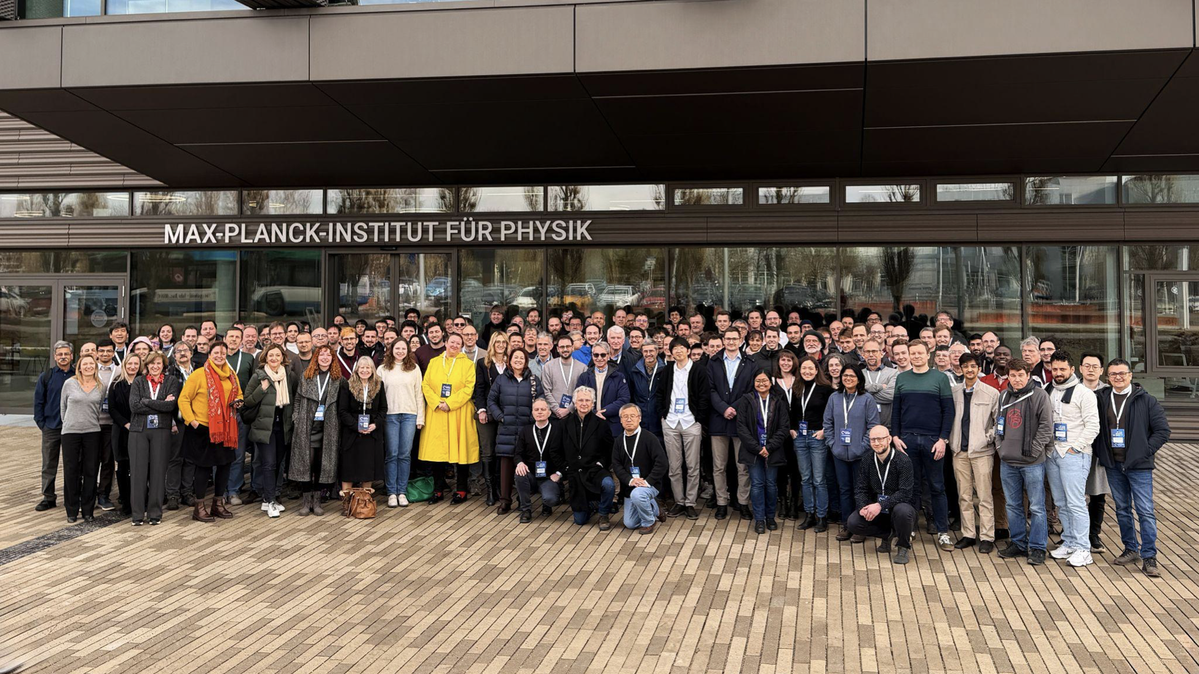
More than 180 physicists, including a large number of early-career researchers, gathered at the Max Planck Institute for Physics in Munich/Garching for the Future Circular Collider (FCC) Workshop 2026. The meeting brought together the particle physics community to discuss recent studies and the overall physics programme and organization of the future FCC-ee, which is now officially endorsed by CERN as its next flagship collider.
The Munich workshop also marked the transition into the pre–Technical Design Report (pre-TDR) phase of the FCC-ee project, essential for coordinating the growing international effort toward a coherent design and physics strategy.
The ETP group at KIT was actively represented at the workshop. Sofia Giappichini presented recent projections on how the FCC-ee could investigate CP violation in Higgs boson decays to tau leptons, highlighting the collider’s potential to uncover new sources of CP violation in the Higgs sector. Results from two ETP bachelor’s theses — by Gregor Bordbeck and Lars Bogner — focusing on tau-lepton reconstruction techniques, were also discussed and received positive attention from the community. Their work has been submitted for publication in two articles.
Prof. Markus Klute emphasized the growing engagement of the German community in the FCC project, underlining German groups' contributions across a broad series of sectors, like accelerator development, detector R&D, simulation studies, and theory calculations.
With the FCC-ee taking shape more than ever before, the task for the community is clear: design it, test it, and stress it from every angle! With ambitious goals and innovative tools, ETP researchers are set to contribute actively to developing the machine that will shape the next era of particle physics.
Contact: Prof. Dr. Markus Klute (markus klute ∂does-not-exist.kit edu)