
World-leading constraints on Axion-like Particles from Belle II Search
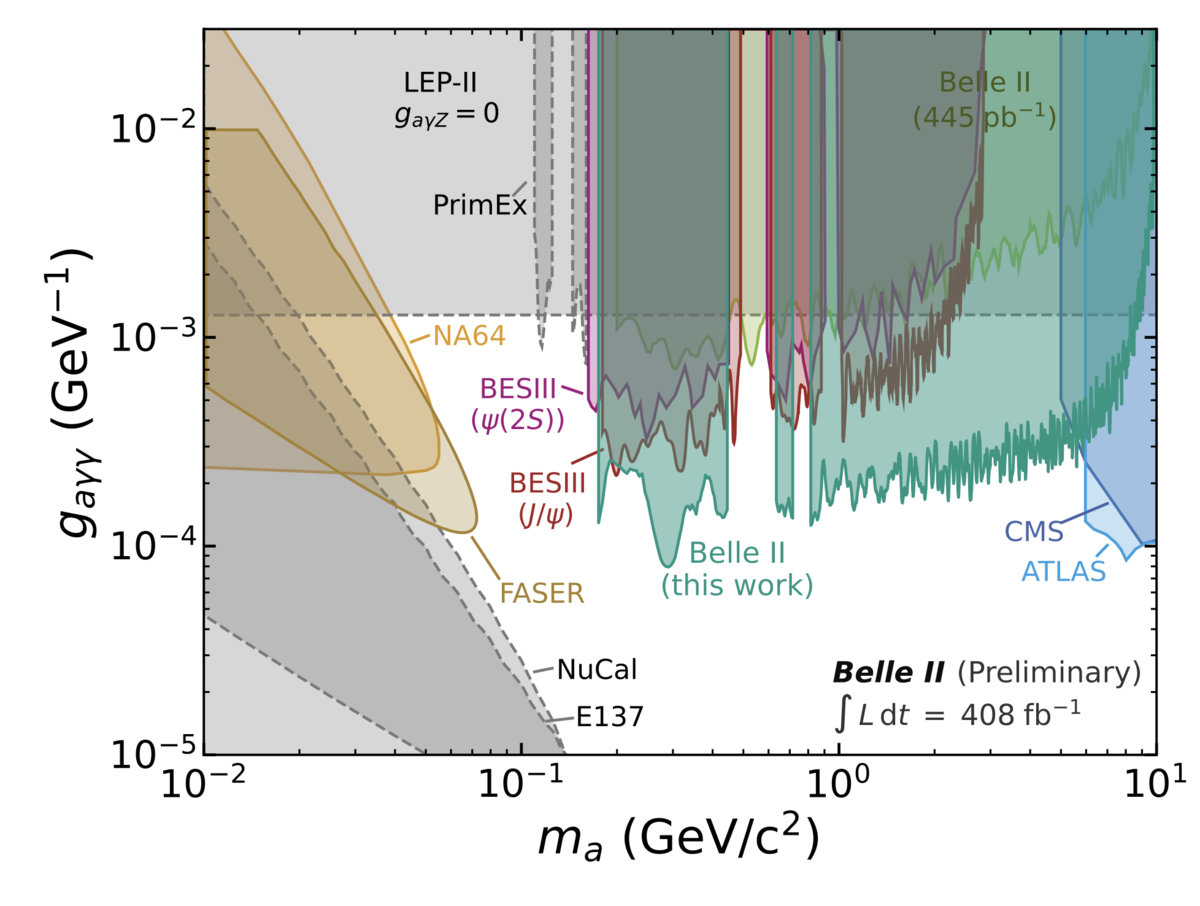
The Belle II Collaboration has carried out a new search for axion-like particles (ALPs) decaying via a→γγ and has set the most restrictive limits to date on the ALP-photon coupling for ALP masses in the GeV range. The analysis is based on an integrated luminosity of 408.1 fb⁻¹, recorded with the Belle II detector at the SuperKEKB collider in Tsukuba, Japan. The search targets the process e+e- -> γa followed by the decay a->γγ, using events with three reconstructed photons in the Belle II crystal calorimeter. The largest local excess, 3.3 standard deviations at a mass of 0.22 GeV/c², reduces to a global significance of 1.4 standard deviations once the look-elsewhere effect is taken into account, and is not interpreted as a signal. The new 95% confidence-level exclusion limits improve on previous measurements by almost one order of magnitude and, now reaching down to 10⁻⁴ GeV⁻¹.
ALPs appear in numerous extensions of the Standard Model and could act as a bridge between the known visible matter and dark sectors. Unlike the original QCD axion, an ALP's mass and coupling strength are not linked by a fixed relation, so a large parameter space has to be probed experimentally. Because the four-momentum of the colliding beams is known far more precisely than any individual photon energy measured in the calorimeter, a kinematic fit can treat it as a near-exact constraint leading to a mass resolution of only 0.2% for the heaviest ALPs. A newly developed neural-network event classifier, using kinematic and topological input variables, further suppresses the dominant e+e- ->γγ(γ) background compared with the previous Belle II analysis.
Alexander Heidelbach, Giacomo De Pietro, and Torben Ferber worked together on the analysis at KIT. The search formed the doctoral thesis project of Heidelbach, who is now a postdoctoral researcher at LMU Munich.
The paper has been submitted to Physics Review Letters (PRL), and a preprint is available on arXiv.
Contact: Prof. Torben Ferber (torben ferber ∂does-not-exist.kit edu)