
Four top quarks open a window to new physics
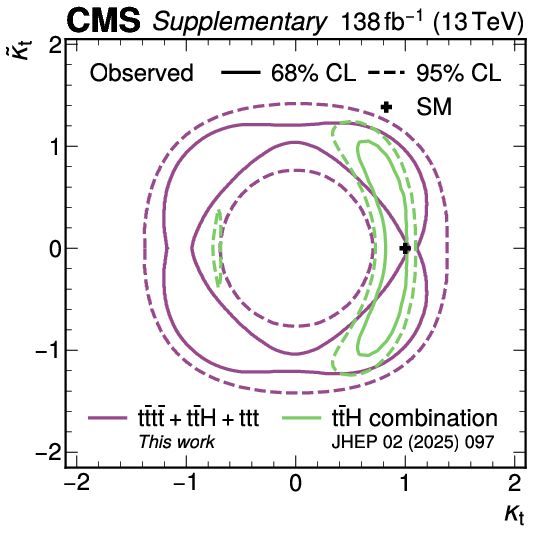
A new study by the CMS Collaboration has explored one of the rarest processes accessible at the LHC: the production of four top quarks in a single proton-proton collision. Because top quarks are the heaviest known elementary particles, they are expected to be particularly sensitive to the effects of yet-undiscovered particles or forces. Four top quark production is extraordinarily rare, occurring only a handful of times among trillions of collisions, but precisely for this reason it provides a powerful opportunity to test the standard model and search for hints of new physics. The new results are based on the dataset recorded by the CMS experiment between 2016 and 2018.
The study examines the data from three complementary perspectives. First, the researchers searched for subtle deviations from standard model predictions that could arise if new physics exists at energy scales beyond the direct reach of the LHC. Second, they looked for evidence of new heavy particles that would preferentially interact with top quarks and could enhance the production of events containing three or four top quarks. Finally, the analysis probed the interaction between the top quark and the Higgs boson, one of the most important relationships in the standard model because it is responsible for generating the top quark's large mass. Although no significant deviations from standard model expectations were observed, the study places some of the strongest constraints to date on several scenarios of physics beyond the standard model. The analysis combines advanced machine-learning techniques with sophisticated statistical methods to maximize sensitivity to these rare processes.
Members of the CMS Collaboration from Ghent, Vienna, and Karlsruhe made key contributions to this work. At the Institute for Experimental Particle Physics, Dr. Joscha Ahäuser was leading the analysis effort and played an important role in the interpretation of the results. The project brought together expertise in top-quark physics, effective field theory, and modern data-analysis techniques, demonstrating the value of international collaboration in addressing fundamental questions about the building blocks of nature. The paper has been submitted to the Journal of High Energy Physics, and a preprint is available on arXiv.