

From Information Geometry to Jet Substructure: A Triality Linking Cumulants, Energy Correlators, and Hypergraphs
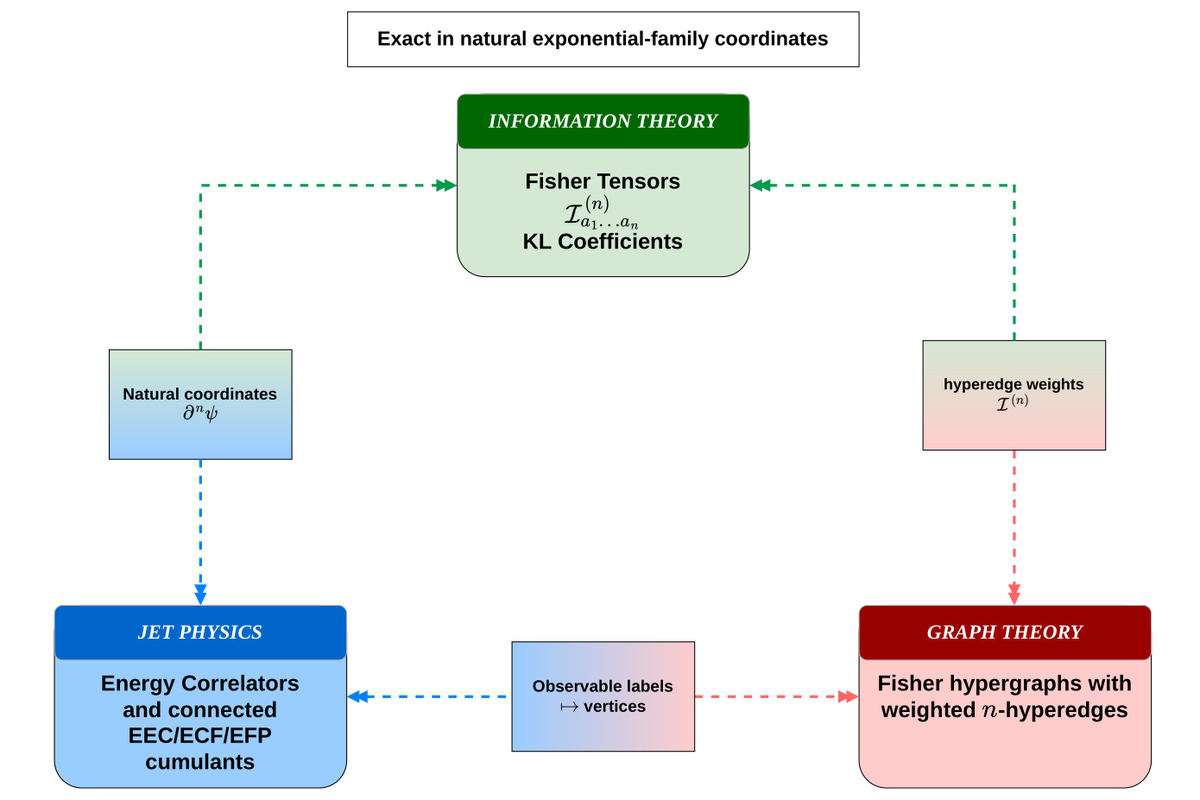
A team of researchers at the ETP, in collaboration with colleagues from theoretical high-energy physics at the ITP, have recently presented a mathematical equivalence between three seemingly distinct objects: higher-order cumulant tensors from information geometry, energy correlator observables in jet physics, and weighted hypergraphs from graph theory. The authors call this equivalence the Fisher–correlator–hypergraph triality.
At the Large Hadron Collider, collisions between protons produce highly collimated sprays of particles known as jets. Characterising the internal radiation patterns of these jets is a central challenge in modern particle physics. A well-motivated approach uses energy correlators: observables that quantify how energy is distributed among pairs, triplets, or larger groups of particles at varying angular separations. A key question in jet substructure is whether a given multi-particle radiation pattern is genuinely irreducible, meaning that it reflects a true joint correlation among three or more particles, or whether it can be explained as an accidental overlap of simpler pairwise effects. Distinguishing these two cases is essential for understanding the underlying QCD dynamics that shape a jet, and for separating jets originating from different physical processes.
The new work begins from the observation: energy correlators describe how energy is shared among the particles present inside such jets, and their statistical fluctuations across many jets carry information about the underlying radiation pattern. The key insight proceeds in two steps. First, a finite set of such observables (either energy correlators, or similar variables known as energy flow polynomials) is treated as the natural coordinates of a local statistical model that describes a reference jet sample. Thereafter, the connected higher-order fluctuations of these observables: the part of a triple or even quadruple correlation that genuinely involves all observables together, are equivalent to the higher-rank cumulant tensors of the statistical model which is assumed to describe the observables (and therefore the jet data). These tensors are a natural extension of the well-known Fisher information matrix to third, fourth, and higher orders, and they measure how distinguishable two nearby radiation patterns are when joint multi-observable fluctuations are taken into account. In practice, this means there is a clean, physically meaningful object that captures genuinely irreducible higher-order correlations among jet observables, separated from the pairwise correlations that second order models already describe well.
The same tensors then simultaneously play a second role: they assign weights in a principled fashion to hyperedges, which are a generalisation of graph edges to orders greater than two. The significance lies in what this construction enables. Ordinary graphs are widely used in machine learning for collider physics, and hypergraph structures extend that toolbox to model genuinely multi-point correlations. The triality provides a principled, physics-motivated prescription for constructing and weighting hyperedges directly from correlator data, rather than treating hypergraph connectivity as an arbitrary architectural choice. This opens a path toward more expressive and potentially more interpretable representations of jet substructure, with tangible benefits for observable compression, classifier design, and physics-informed message passing in graph and hypergraph neural networks.
This work was carried out by postdoc Dr. Aritra Bal, working in the group of Prof. Dr. Markus Klute, and Prof. Dr. Michael Spannowsky. The results are available as a preprint on arXiv and will now undergo peer-review for publication in a journal.