
New Perspectives on the Universe: Particle Physics Meets Gravitational Waves
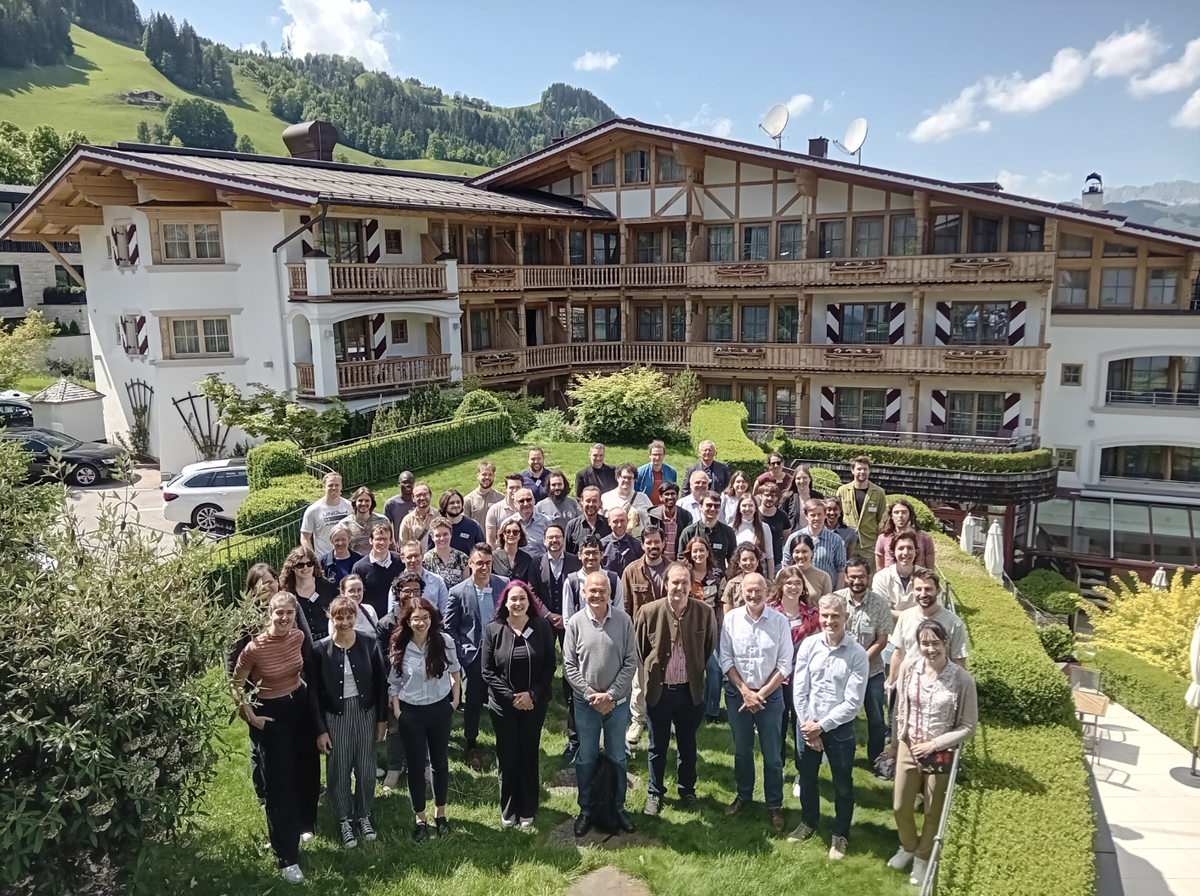
What can gravitational waves tell us about the fundamental laws of nature? A recent perspective article, emerging from a scientific workshop in Kitzbühel, brings together researchers from particle physics, astrophysics, and cosmology to explore this exciting question.
The workshop was made possible with the support of the Wilhelm und Else Heraeus-Stiftung, whose long-standing commitment to scientific exchange continues to foster new collaborations across disciplines. The meeting was led by Steven Bass, who served as the main organizer and later as the lead editor of the resulting publication. Markus Klute (ETP) co-organized the workshop and contributed to the discussions on future Higgs measurements.
The resulting article highlights how gravitational waves and particle physics experiments provide complementary windows on the Universe. Signals from merging neutron stars and black holes can reveal the nature of dense matter, dark matter, and even possible phase transitions in the very early Universe. At the same time, collider experiments such as the HL-LHC and future Higgs factories probe the properties of the Higgs boson and search for physics beyond the Standard Model.
A particular focus of Klute’s contribution was the role of future precision Higgs measurements, especially the Higgs self-coupling. This quantity is crucial for understanding the shape of the Higgs potential and may be directly connected to cosmological phase transitions that could leave an observable imprint in the gravitational-wave spectrum.
The article highlights the growing importance of interdisciplinary collaboration in addressing some of the most profound open questions in physics - from dark matter and the Higgs sector to the evolution of the Universe itself.
Contact: Prof. Dr. Markus Klute