
Smarter Recycling with AI: Master’s Thesis Achieves State-of-the-Art Results
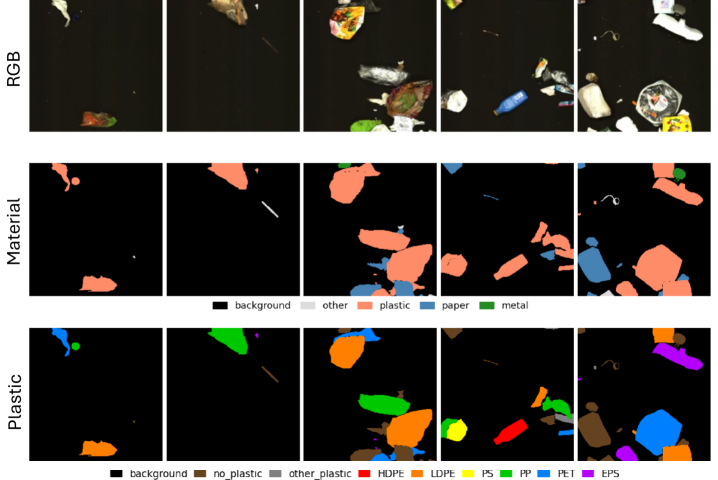
How can we improve recycling in an increasingly complex waste stream? In a joint master thesis project between the Frauenhofer Institute for Optronics, Systems Engineering, and Image Analysis (IOSB) and the ETP, Jonas Funk has taken an important step toward answering this question using modern artificial intelligence.
In a recent study, he developed a new method that combines conventional camera images with hyperspectral data, an imaging technique that reveals the material composition of objects. While standard images capture shapes and colors, hyperspectral sensors can distinguish materials that look identical to the human eye, such as different types of plastic. The key idea is to intelligently fuse both sources of information. The newly developed approach enables highly precise, pixel-level identification of waste items, even on fast conveyor belts. This is essential for automated sorting systems used in modern recycling plants. The method achieves state-of-the-art performance while remaining fast enough for real-world applications. It was tested both on established benchmarks and on a newly recorded dataset from an industrial setting.
This work highlights how cutting-edge AI research at ETP can contribute to practical solutions for sustainability - and how young researchers play a key role in driving innovation.
Contact: Prof. Dr. Markus Klute