
ETP at ErUM-Data meeting in Berlin on AI, digital infrastructures, and technology transfer
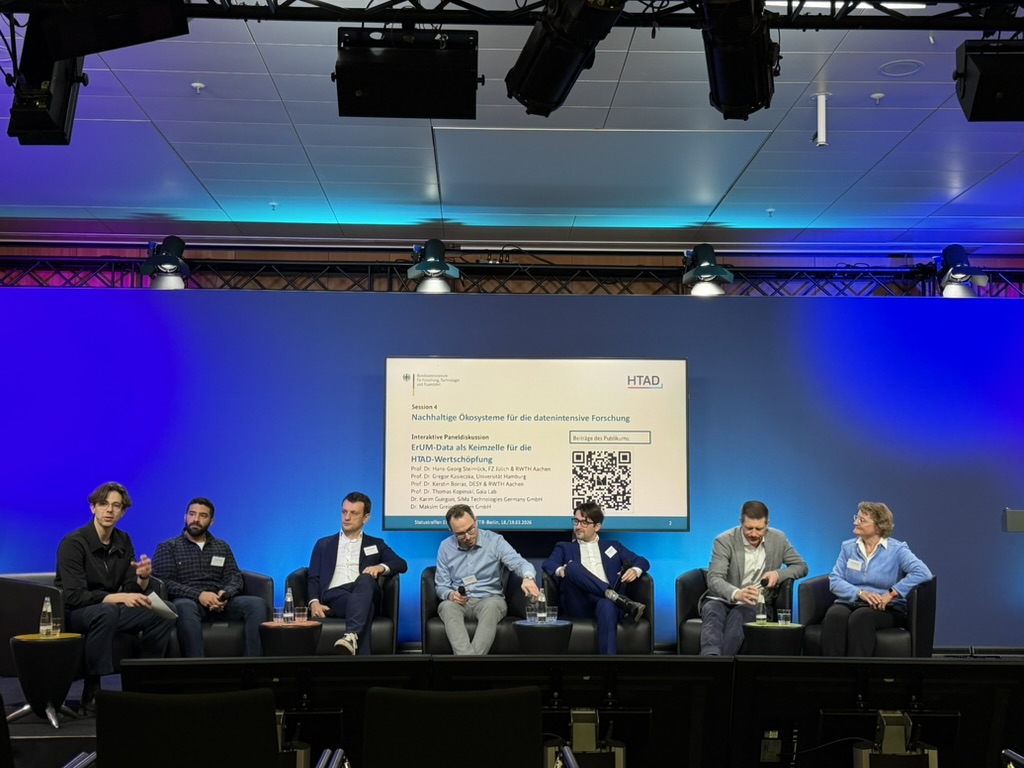
The BMFTR invited projects funded under the ErUM-Data action plan to Berlin. The meeting addressed the role of artificial intelligence as a driver of scientific progress and value creation. The ErUM-Data action plan focuses on the digital transformation of data-intensive fundamental research at large-scale facilities. Experiments at particle accelerators, photon sources, and observatories produce large volumes of data that require coordinated approaches in data management, computing infrastructure, and algorithm development. The program aims to convert these data into structured and usable information and to enable efficient analysis workflows. Three main areas are addressed within ErUM-Data: research data management according to FAIR principles, federated digital infrastructures, and the development of advanced software and algorithms, including machine learning methods. The program brings together expertise from physics, computer science, and data science, and includes collaboration with industry partners.
The ETP plays a leading role within ErUM-Data through its involvement in three projects and the coordination of two of them, BRAID and DEEP. These projects address key challenges at the interface of algorithms, hardware, and large-scale data processing:
- BRAID develops AI-based frameworks for the reconstruction of physics signals in irregular, high-dimensional data. The approach targets scenarios where conventional reconstruction methods face limitations due to data complexity and detector geometry.
- DEEP focuses on deploying machine learning algorithms directly on embedded hardware close to the detector. The aim is to perform data reduction in real time at the source, thereby addressing the increasing data rates expected in current and future experiments.
- SUSFECIT addresses the computational infrastructure required for these developments. It focuses on federated and sustainable compute models, with the goal of enabling scalable and resource-efficient data processing across distributed systems.
The ETP activities are embedded in the broader context of the Hightech Agenda Deutschland, which defines strategic priorities for technology development, including artificial intelligence and microelectronics. Representatives from the BMFTR and from industry participated in the meeting and contributed to the discussions. The meeting focused on technology transfer, on the role of ErUM-Data in training highly qualified personnel who contribute to industry, and on improving career mobility between academia and industry.