
Real-time graph neural networks on FPGAs for the Belle II electromagnetic calorimeter
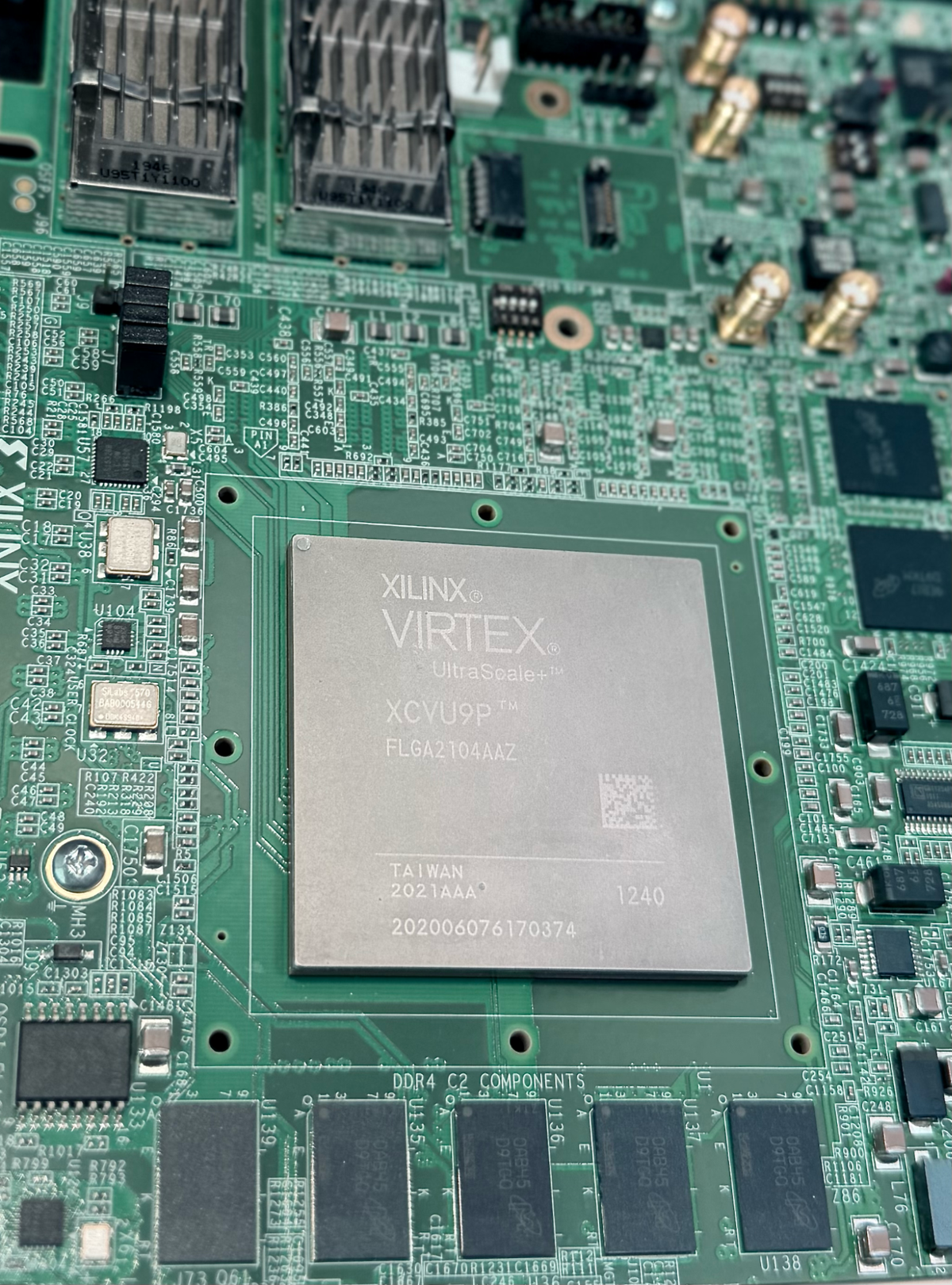
Researchers at the Institute of Experimental Particle Physics and the Institute for Information Processing Technology at the Karlsruhe Institute of Technology have developed and deployed a real-time Graph Neural Network-based trigger for the electromagnetic calorimeter of the Belle II experiment at the SuperKEKB collider in Tsukuba. The system is integrated into the first level trigger, and processes 8 million events per second with a fixed latency of 3.168 microseconds before data are permanently stored. It is the first Graph Neural Network reconstruction system operating on Field Programmable Gate Arrays (FPGAs) within the real-time trigger readout path of a collider experiment.
FPGAs are programmable logic chips that allow the implementation of custom digital circuits. Unlike CPUs and GPUs, which execute software instructions on fixed processor architectures, FPGAs map computations directly into hardware logic. This enables a very low deterministic latency and extremely high throughput. Latency refers to the time between receiving detector data and issuing a trigger decision. In collider experiments such as Belle II, this interval is strictly limited because detector data are buffered only temporarily. The reported latency of 3.168 microseconds means that all computations are completed within this fixed time window.
The algorithm development and physics performance evaluation were led by Dr. Isabel Haide during her doctoral research at KIT. The FPGA implementation was led by doctoral researcher Marc Neu. Master’s students in physics and electrical engineering contributed to development and validation. The trigger reconstructs and classifies energy deposits from particle collisions in real time, achieving improvements in position resolution, cluster purity, and cluster efficiency. An additional classifier provides further background suppression to mitigate increasing beam background levels at Belle II.
The work has been submitted to JINST and is available as a preprint. The training and evaluation software is publicly available. Additional components of the project have also been released as open source, including the Quantized GravNet implementation, a custom QKeras fork, and the hardware implementation code.
Contact: Prof. Torben Ferber (torben ferber ∂does-not-exist.kit edu), Prof. Jürgen Becker (juergen.becker@kit.edu)