

Solving the puzzles of charming resonances
Semileptonic B-meson decays involving multiple final-state hadrons play a crucial role as backgrounds to studies of lepton flavour universality such as R(D(*)) determinations.
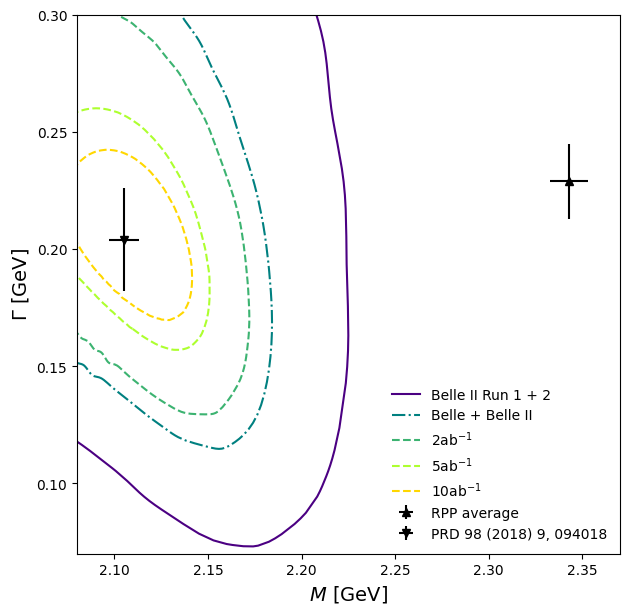
Decays of this type generally constitute poorly understood orbitally excited states of the charmed meson, collectively referred to as D**, as well as non-resonant contributions of B → Xclν that remain largely unmeasured. Recent studies have shown that the scalar member of the D** family, the D0*, is in fact an overlap of two resonances, which suggests that the S-wave lineshape is not described by a simple Breit-Wigner distribution. In addition, the mass and width of the D0* are in puzzling tension with predictions from unitarized chiral perturbation theory (UChPT) and lattice QCD, which favour a lighter state at around 2100 MeV. However, to date, no direct experimental evidence for this lighter state exists.
Researchers at ETP, Forschungszentrum Jülich, University of Bonn, University of Zurich, Chinese Academy of Sciences and University of Electronic Science and Technology of China have recently proposed a novel measurement at the Belle II experiment to facilitate a direct observation and improve our understanding of these decays. Belle II is particularly well-suited for this analysis due to the distinct experimental setup of a precisely known initial state, coupled with an almost exclusive production of a BB pair through the Υ(4S) resonance. By exploiting this unique event topology, one of the bottom mesons can be fully reconstructed through purely hadronic decay chains, allowing for the kinematics of the remaining bottom meson to be inferred using conservation constraints - a method called hadronic tagging. The proposed measurement utlizes this reconstruction technique to measure the angular-asymmetry observables of B → Dπℓν decays in bins of the invariant Dπ mass spectrum. Using this information allows for the direct extraction of the Dπ S-wave phase shift, which provides the necessary experimental input to determine the pole of the D0* through a model-independent K-matrix fit.
The research team conducted a sensitivity study, finding that the Belle II experiment can determine the pole location with sufficient precision to firmly establish the D0*(2100) using the currently available data set. Consequently, the results of the proposed project will significantly improve our understanding of the spectroscopy of charmed mesons.
The research has been published in the peer-reviewed journal Eur.Phys.J.C 85 (2025) 11, 1289 and is also available as a preprint.
Contact: Dr. Raynette van Tonder (raynette vantonder ∂does-not-exist.kit edu )