
Machine Learning for Reusable Precision Measurements
Researchers at ETP have developed a new machine-learning–based analysis method that improves the precision of collider measurements while keeping results transparent and reusable. The method, called the Optimal Observable Machine (OOM), was developed by ETP Master’s student Torben Mohr in collaboration with international partners.
In high-energy physics, measurements are based on observables reconstructed from detector data and later corrected for detector effects before comparison with theory. While modern machine-learning methods can improve sensitivity using detector data, they often produce results that are difficult to reinterpret or reuse, because the learned quantities are not defined in a way that allows a clean correction for detector effects. The OOM addresses this by learning a single, physically meaningful observable that captures the information relevant for a chosen physics parameter.
Crucially, this observable is defined at the level of the underlying particle interaction, but is constructed such that it remains reliably measurable once detector effects and uncertainties are taken into account. These effects are already included during training, allowing the method to optimise expected measurement sensitivity under realistic experimental conditions rather than simple classification performance.
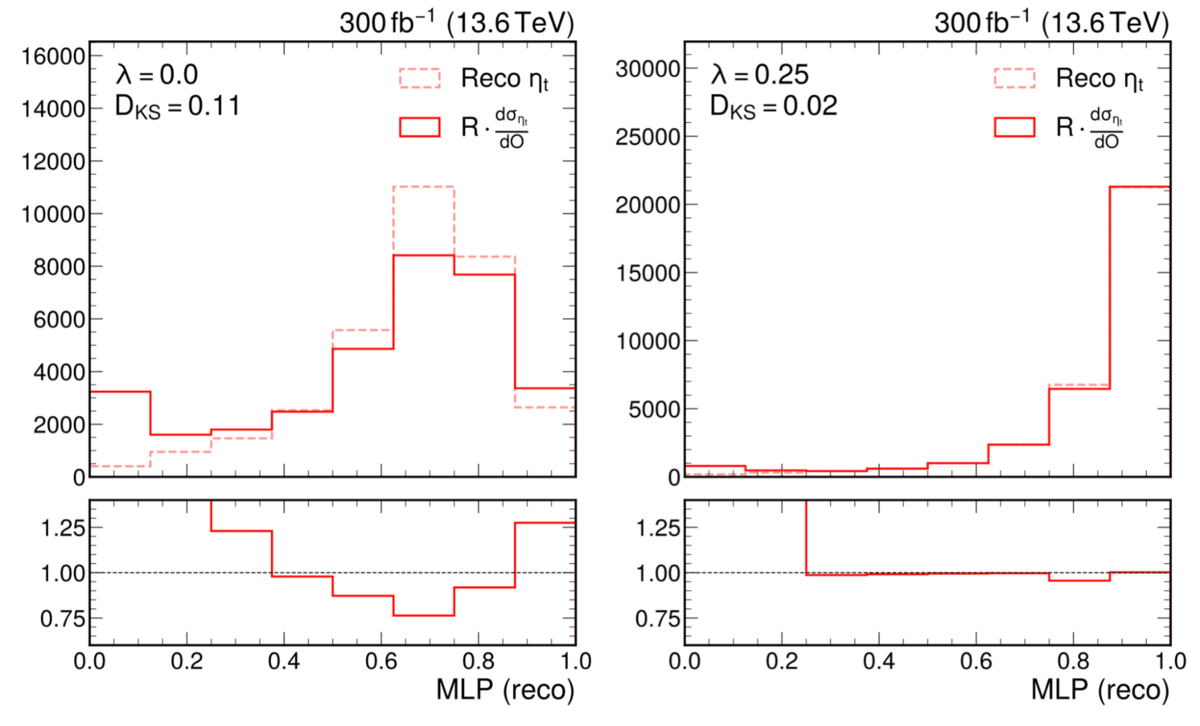
As a proof of principle, the OOM was applied to a current LHC physics question: a small excess near the top–antitop production threshold. Using simulated data, the method enhances sensitivity to such effects while preserving the ability to reinterpret the result as theoretical models evolve. The study demonstrates how machine learning can support both precision and long-term scientific reuse of collider measurements.
Contact: Prof. Dr. Jan Kieseler